Configure Payroll Controls
This article explains how to configure Payroll Controls in Zenoti to ensure accurate, fair, and flexible payroll processing. You’ll learn how to define payroll hour calculations, compare hourly pay against commissions (including service and product), handle overtime-based compensation, configure look-back periods, and award bonuses when guests request specific providers.
Overview
Zenoti’s Payroll Controls provide a centralized way to manage how employee compensation is calculated across your organization. With payroll controls, you can:
Accurately track hours using actual check-in/check-out data or scheduled hours.
Ensure fair compensation by comparing hourly pay (including overtime) with commission earnings.
Zenoti automatically calculates employee pay based on the employee’s overtime eligibility. For overtime-exempt employees, the system uses the average commission earnings from previous pay periods (based on the configured look-back period) to determine fair compensation. If no commission payout exists for the look-back period, Zenoti assumes commission pay is lower than hourly wages and pays the employee based on their hourly pay.
Award bonuses when a guest requests a specific therapist during booking—encouraging personalized service and employee recognition.
These configurations are especially valuable for businesses with commission-based roles such as stylists, therapists, and salon managers, who may earn varying amounts depending on sales performance and working hours.
Set payroll calculation method
Go to Configuration > Employee > Payroll and Commissions > Payroll Controls at the center level.
Under Calculate payroll hours / Employee utilization based on, select one of the following options:
Scheduled and actual hours combination
Actual check-in/check-out time
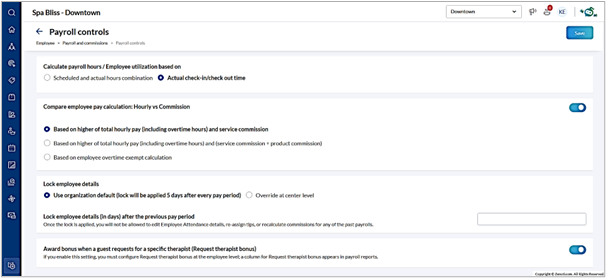
Enable comparison of Hourly Pay vs. Commission
Go to Configuration > Employee > Payroll and Commissions > Payroll Controls at the center level.
Switch on the Compare employee pay calculation: Hourly vs Commission toggle.
If your payroll only considers service-based incentives, select the Based on higher of total hourly pay (including overtime hours) and service commission option.
If your payroll includes product sales as part of commissions, select the Based on higher of total hourly pay (including overtime hours) and (service commission + product commission) option.
If your payroll calculation depends on overtime eligibility, select the Based on employee overtime exempt calculation option.
Note
For users who used the old Employee pay using hourly pay and service commission comparison setting:
If the old setting was set to None, the Compare employee pay calculation: Hourly vs Commission toggle is turned off by default.
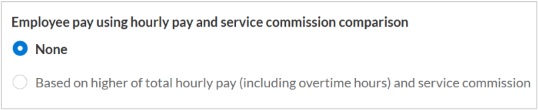
If the old setting was set to Based on higher of total hourly pay (including overtime hours) and service commission, the new toggle is turned ON automatically, and the corresponding radio option is pre-selected.
The Payroll report will include a new column titled Hourly Pay/Service Commission + Product Commission, which displays the higher value used for employee compensation.
Compare commission with hourly pay for selected work tasks
When your employees work across multiple work tasks with different hourly rates, you can control exactly which tasks are eligible to have their hourly earnings compared against commission. Tasks you mark eligible participate in the comparison; all others are always paid hourly. Overtime is calculated afterwards using a weighted average regular rate that includes commission, so calculations remain accurate whether an employee hits daily overtime, weekly overtime, or both.
Before you enable this at the center level:
Work tasks must be enabled at the organization level.
The organization-level setting Allow commission comparison based on selected work tasks must be turned on. See Manage work tasks.
At least one work task must be marked commission-eligible on the Centers tab of the work task configuration.
Employees must have the relevant work tasks assigned to their profile.
Commission comparison for work tasks is controlled by the center setting and the work task eligibility flags. There is no employee-level override. For each employee, commission is compared only against the hourly earnings of work tasks that are both enabled for commission comparison at the center and assigned to the employee.
Required roles: Any role with access to the Administrator mode
Required permissions: None
At the center level, navigate to Employee > Payroll Controls > Compare Employee Pay Calculation.
Depending on how commission is tracked at your center, select one of the following:
Compare service commission with straight-time hourly pay for selected work tasks: Service commission is compared against the straight-time hourly earnings of the employee's eligible work tasks on a weekly basis. Overtime premiums are calculated separately and applied after the comparison.
Compare service and product commission with straight-time hourly pay for selected work tasks: Combined service and product commission is compared against the straight-time hourly earnings of the employee's eligible work tasks on a weekly basis. Overtime premiums are calculated separately and applied after the comparison.
Click Save.
How the calculation works
Zenoti calculates commission comparison and overtime on a weekly basis, even if your pay period is bi-weekly or longer. This keeps each week compliant on its own terms — one week's overtime or commission cannot subsidize another. For each week, Zenoti:
Captures daily hours per work task and aggregates them into weekly totals.
Identifies the work tasks that are both commission-eligible at the center and assigned to the employee.
Calculates straight-time hourly earnings for every work task using its own hourly rates.
Combines the hourly earnings of the eligible work tasks and compares the total against the employee's commission (service only, or service plus product, depending on the setting you chose). If commission is higher, commission replaces the hourly earnings for those eligible tasks.
Adds the hourly earnings from non-eligible work tasks, which are always paid hourly.
Computes the regular rate as total straight-time earnings divided by total weekly hours. This rate is used for overtime.
Applies daily and weekly overtime. If both apply in the same week, Zenoti uses whichever produces more overtime hours and does not count the same hour twice. The OT premium is calculated as 0.5 × regular rate × overtime hours.
Adds the OT premium to the straight-time earnings to produce final pay.
If an employee does not earn any commission during the week, their pay is calculated from hourly rates and overtime as defined in their employee profile.
Example 1: Multiple work tasks, no commission
An employee works 44 hours across four work tasks in the week:
• Provider: 20 hours at $20 = $400 • Receptionist: 10 hours at $25 = $250 • Admin: 8 hours at $18 = $144 • Inventory Manager: 6 hours at $30 = $180 • Total: 44 hours, $974 straight-time earnings
The employee has 4 hours of weekly overtime (anything above 40). The regular rate is $974 ÷ 44 = $22.14. The overtime premium is 0.5 × $22.14 × 4 = $44.28. Final pay is $1,018.28.
Example 2: Commission replaces hourly for eligible tasks
The same employee works 44 hours with the same breakdown. Only the Provider task is commission-eligible. During the week, they earn $600 in service commission. The Provider task produces $400 in hourly earnings. Since $600 in commission is higher, commission replaces the Provider hourly for the week. The three non-eligible tasks add $574 in hourly pay. Straight-time earnings for the week total $1,174. The regular rate is $1,174 ÷ 44 = $26.68. The overtime premium is 0.5 × $26.68 × 4 = $53.36. Final pay is $1,227.36.
Example 3: Multiple eligible work tasks
The same employee has two commission-eligible tasks: Provider and Inventory Manager. Their combined eligible hourly earnings are $580. Their service commission is $650. Commission is higher, so $650 replaces the combined Provider and Inventory Manager hourly earnings for the week. The non-eligible Receptionist and Admin hours are added to straight-time pay as usual. Overtime is then calculated from the combined total.
Configure the Look-back Period (For Overtime-Exempt Calculation Only)
When the Based on employee overtime exempt calculation option is selected, you’ll see a Look-back period dropdown list. This is used for employees with no historical payout data during the selected period.
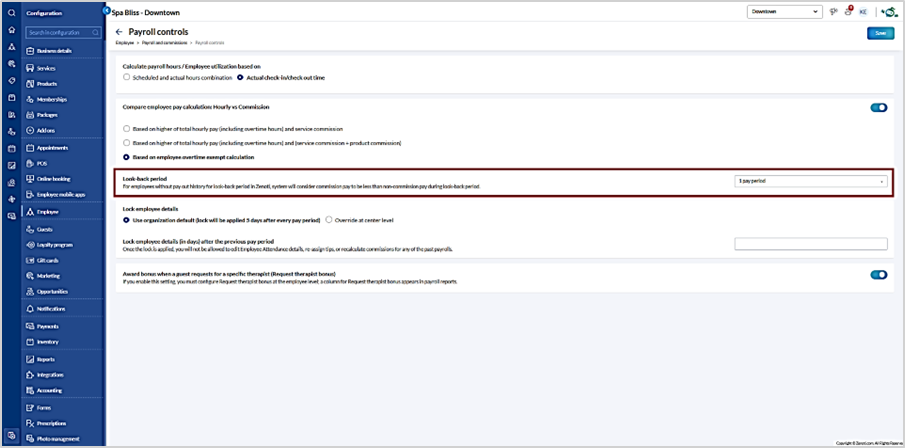
Choose from:
1 pay period
2 pay periods
3 pay periods
Zenoti uses this setting to determine a baseline for commission earnings when an employee has insufficient payout history.
Note
If no commission data exists in the selected look-back period, the system assumes commission pay is lower than hourly wages.
Enable Request Therapist Bonus
You can award a bonus when a guest explicitly requests a specific therapist during booking:
Switch on the Award bonus when a guest requests for a specific therapist (Request therapist bonus) toggle.
Configure the bonus amount in each employee’s profile under the compensation settings.
The bonus appears as a separate column in payroll reports, making it easy to track and process.
Impacts and considerations
The Look-back period setting only appears when Based on employee overtime exempt calculation option is selected.
These settings are applied at the center level. However, individual overrides can be configured per employee.
Ensure employee overtime classification is accurate to avoid incorrect payouts.
Request therapist bonuses must be manually assigned in each employee's profile.